Thursday, June 30, 2011

Sojourn in the Norwegian Sea

As is often the case when jet-lagged by travel, our night was uneven. We were first rocked to sleep by the swaying of the ship (the Sojourn), then awakened by biorhythms unaccustomed to this time zone (6 hours ahead of Charlotte). So I was awake at 3:30 AM in the few hours of darkness days have here (about 11PM-4AM), watching the lights of other ships in the sea and reading in an attempt to get back to sleep.

I woke again around 6:30AM when Mike brought in tea from the coffee bar at the stern end of our deck. Our cabin is almost all the way forward¸ so we're getting some exercise just moving around the ship. We took advantage of u-shaped walkway a couple of decks below for our morning walk, mostly under cover. but cool in the morning air as the ship powered through somewhat windy seas.
We had to learn how to use the very efficient and modern shower, then followed our noses to the varied and tasty breakfast buffet. Mike signed us up for a tour of the ship's bridge, a geek's dream with its array of electronic marvels from GPS to radar, all backed up by alternatives. In the midst of such modern equipment, it was amusing to see the fairly simple way in which the bridge is constructed to help them bring it alongside piers for docking. There are control stations in wings on each side of the ship where the captain or pilot can operate it. Included at each station is a glass insert in the floor so that they can actually look down to see that they have positioned this huge vessel exactly where they want it.

On a white board in the bridge are listed facts about who is on the ship, listing the numbers aboard of crew members, "PAX" for passengers and "SOB" for souls on board. The Second Officer, Johanna from Finland, was our guide and made it all sound both efficient and amazing. The view from the bridge is amazing and they have an officer acting as lookout at all times in addition to the officer(s) who monitor the equipment. The lookout literally keeps his eyes on the sea ahead and around the ship. It is somehow reassuring that they have both the most up-to-date equipment and keen human eyes on the job.

The rest of the day has included lunch (cruises are always about food and more food and the Sojourn doesn't disappoint us in this area), a lecturer offering some history of Norway, cards and meandering. The lecture, while interesting, still inspired some napping. The poor guy was talking to people who had already consumed two meals and were being constantly rocked by the ocean. I think only a few fell asleep right in front of him; I napped in our room as his voice lulled me via the television broadcast.

The card game was made happier by our onboard barrista who cheerfully made me a Jamaican Latte, more than half of which was a lovely dark rum. Mike, of course, hoped that I would be less wily in my card play, but I managed to overcome the rum and beat him anyway. Perhaps next time he will seek the power of rum for himself.

Not wishing dress up for the "formal optional" evening tonight, we are enjoying the room service option instead, preparing to dine in view of the passing waves, maybe watch a movie. They have films available that are in theaters now, so we may opt for "The Green Hornet." The service and choice for both food and entertainment here is as good as we've ever had anywhere and it's easy to be utterly spoiled. It's a recipe for a wonderful vacation.

Tomorrow we'll be miles into our first fjord and we look forward to our first venture onto Norwegian soil and a railway trip, as well. When those of you in the U.S. are still fast asleep, we anticipate oohing and aahing over beautiful blue waters, mountainsides and the many photo ops we'll have to share at the end of our Friday in Norway's Vestlandt.

Charlotte to Copenhagen and On to Norway


As I write this we are sailing from Copenhagen, Denmark, on the Sojourn, a Seabourn ship. Getting here was a bit of a trial, flying from Charlotte Tuesday afternoon to Atlanta, then through the night to land in Copenhagen Wednesday morning. Unfortunately, neither of us slept much, so cranked off the plane at the airport feeling as twisted as pretzels.

We did have one of those felicitous moments in the departure gate at Hartsfield-Jackson Airport in Atlanta that travelers sometimes experience. While lining up to board, we chatted with a woman from the San Francisco area who asked us where we were from. When we replied "Charlotte," she asked if we knew Giverny. That's our neighborhood and we discovered that her family moved to the Bay area about the same time we moved to Charlotte. We seem to be reminded often that this is a small world.

Once in Copenhagen¸ feet on the ground and weary bodies unkinking, we enjoyed a ride through the city with a driver who gave us quite a bit of history on the way to the harbor. It's not a huge city, but it was founded in the 12th century, he said, and has wonderful buildings, including twisted towers, and green parks. The water is never far away, seagulls float overhead and today's weather has been picture perfect. There's a Carolina blue sky (perhaps they would say Danish blue) and the blades of the wind farms offshore are turning steadily. Our driver told us that Denmark generates more than 20 percent of its electricity from wind.

Despite our weariness, we made the obligatory safety muster, learning to put on our life jackets properly. Then there was a party on the pool deck as we prepared to sail. We watched a couple of much larger cruise ships move out ahead of ours, then began making our way toward Flam up Norway's west coast. There are sailboats all around, windmills in the water and a really long bridge in the distance. So much of Scandanavia is made up of islands that bridges and ferries are a part of life.

I am enjoying the throb of the engines under the decks. It feels as if the ship has a beating heart. We both relish the occasional roll of the ship beneath our feet and know that the swaying will rock us to sleep tonight, as if we needed any help as tired as we are now.

As I close, we are passing beautiful farmland, green pastures spread across the lowlands along the coast. Based on the World Atlas provided in our stateroom, what we are seeing must be in Sweden. Our course will take us up through the Kattegat and the Skagerak, relatively narrow waterways that wind up from Copenhagen to the Norwegian Sea where we'll go north in and out of the fjords before coming back to Oslo and Copenhagen for our return home. The captain has warned that we might have some rougher seas ahead, but, for now, it's truly smooth sailing.

We'll be at sea all day Thursday, a perfect time to catch up on our rest, find our way around the ship and just enjoy the cool breezes here. It is heavenly to have 70-degree days ahead and we don't even mind the rain in the forecast. After the early summer heat in the South, the cooler temperatures here are blissful.

The Danish Coast

Monday, April 4, 2011

10 Things I’ve Learned on Long Walks

I’ve become a bit of a hiker lately. Why? you might ask (as I do myself when miles from home). Mostly because this is one of the few ways to exercise that I can actually enjoy. At this stage of my life, it gets ever harder to willingly do those things I don’t enjoy.

In the past two days, I’ve walked about three-and-a-half miles each day (spelled out this way to help underscore the distance). Yesterday I took my camera and meandered a bit, stopping to take pictures along the way. Today I was given a mission from my husband to retrieve a bottle of catsup from the grocery store. I accepted the challenge because it’s a favorite walk and Starbucks is next to the grocery store; they have my favorite iced tea.

What I’ve learned is that it’s not just exercise; it’s a learning experience. And so, here are 10 things I’ve learned on my long walks.

#1 – I’m not much of a photographer. Despite the fact that I live with an accomplished photographer (my husband, Mike) and I know some talented photographers whose work I admire (Joye Arden Durham and Stephanie Egan), I do not share their gift for this. I do, however, believe I might be the first Impressionist photographer. An inability to focus accurately on subject matter can result in the “painted tulips” you see above.  Hard to believe I once made a living taking photographs!
#2 – Joggers do not smile while jogging as much as walkers do when walking. I suspect they (the joggers) are unhappy because their ankle bones are working their way up to their rear ends, painfully. Admittedly, I have encountered the occasional unsmiling walker, but there is always a percentage of people with deep psychological miseries for whom even a good walk is not an antidote.

#3 – People in cars are alternately very polite to walkers crossing the street into which they want to turn or, frighteningly, oblivious to the walkers until they jam on their brakes, causing walkers to become jumpers. It pays to be watchful when crossing a street that is clear of cars when you step out; they will sneak up on you.

#4 – I notice something new every time I walk. These are streets I’ve driven on for more than a decade, but driving doesn’t allow one to notice the hundreds of details of landscaping and architecture that one sees when walking. Honestly, I’m seeing houses I’ve never actually noticed at all, as well as the amazing beauty on these spring days of flowers, both cultivated and wild.

#5 – Dreams have a way of surviving, even when circumstances conspire to defeat them. There are several pieces of land along my walks that were being developed several years ago, but that were stymied by the economic downturn. Some houses sat unfinished for a couple of years, but now building is beginning again. At least a couple of workers are back in the development with a Mediterranean flair that has only one mostly finished home to go with its dry fountains and walls bright with yellow vines.

#6 – My Southern upbringing requires that I acknowledge people as I meet them on the sidewalk. It’s interesting to note how many people seem surprised that I speak, but most do speak back. Some people say we’ve lost our social skills. Maybe we’re just not practicing them as much because we’re in cars or in public places where we’re actually trying to maintain our bubble of privacy against all those we don’t know.

#7 – Despite lifelong teasing about my pale skin, my über-whiteness does not cause accidents. One of the health benefits of being outdoors in the sunshine is absorbing Vitamin D. Since my doctor seems concerned that I might not be getting enough Vitamin D to keep my bones healthy (rickets, anyone?), I’ve allowed myself to take my absurdly white skin out where it can be seen, potentially causing accidents when drivers are blinded by the sun’s reflection off my legs. Thus far, no crashes have occurred.

#8 – Grocery check-out clerks must experience a lot of strange things. When I went into the store to purchase the aforementioned catsup for my husband, I sensed that the young man checking me out was cool with the old lady in the Paddington Bear hat and sunglasses quibbling about the price of the catsup and handled it well until I told him I didn’t need a bag because I could put it in my backpack. I suspect he’ll have an extra beer when he gets off work tonight and maybe his buddies will pay for it when he tells them about weird old lady with what he probably perceived as dementia.  He was kind, but I noticed that he backed away when I rejected the bag and took off my backpack to put in the catsup.

#9 – Music is, in fact, the universal language. When stopping for my iced tea at Starbucks, I picked up an Adele CD while waiting. This began a five-minute conversation with the young woman behind the counter in which we traded favorite musicians and songs, ranging from the Avett Brothers to Joss Stone, Ruthie Foster, Grace and the Nocturnals and Tyrone Wells. She was right about Wells.  His “Seabreeze” is now on my iTunes list to download. I hope she likes the ones I suggested that she hadn’t heard.

#10 – Whether you’re traveling halfway around the world or just walking a few miles, it’s nice to come home again. One of the pleasures of my walks is the simple one of coming up the walk and into the front door. When we’re in the car, we come in through the garage and kitchen door. That's okay, but this front door thing is different.  There’s something satisfying about entering the house, especially after a good walk, something that says I’m home and reminds me of the first time I came into this house and why, after looking at so many others with the realtor, we came back to this one. We felt at home here, somehow knowing that this would be a great place to return from life’s experiences, a place of comfort and peace, a place to share with family and friends. Somehow all those feelings come back to me more vividly when I walk through that front door.

Tuesday, March 8, 2011

Weekend Wandering

One of the joys of retirement is the freedom to explore. So we wander often, discovering new places that are sometimes just up the road or around the bend.

This past weekend, despite a misty day on Saturday, we decided to go to Old Fort, NC. We’ve seen the road that turns off NC Highway 9 many times, but have always been on our way to or from somewhere else. When days are scheduled, it’s easy to pass up those side roads. But this day our plan was simply to wander around Old Fort.

So off we went, stopping long enough just above Chimney Rock Village for lunch at the Esmeralda Inn. The current owners of this historic spot have created a beautiful inn and serve meals from creative menus. This is a place, they say, where Mary Pickford, Gloria Swanson, Clark Gable and other Hollywood stars once came, first to make silent movies, later to get away from the glare of their fame. It remains a quiet haven for those who would escape life’s sometimes frantic pace.

The original Esmeralda, built in 1892, burned down, but was rebuilt and now has the protection of modern safety standards. It sits on a slope above Highway 9/64/74A as the road twists and turns alongside the Rocky Broad River in Hickory Nut Gorge. Guests can sit on the covered front porch and hear the river as it splashes over the boulders that give the river its name.

On such a wet day, we enjoyed our late lunch with the dining room pretty much to ourselves. Our friendly waiter brought us hot, savory vegetable beef soup and my favorite, a fried green tomato BLT. We dined at a window table in view of the budding trees and flowering daffodils. My guess is that, after a too-dry spell in this area, the plants were all thirstily drinking in the rain.

We found our way to Old Fort road with its ups and downs and curves through the mountains. There were stretches of road with no habitation, just the eerie tall woods in deep ravines, filled this day with thick, swirling fog. In other places there was that strange mix of homes one finds in a developing area like this. Old farmhouses and mobile homes flanked the entrances to gated high-end developments. Occasionally we saw a mountain mansion showing off its log exterior on a ridge above us. They wouldn’t have had much of a view in the rain, but their sunrises and sunsets must be glorious on better days.

Finally we came to Old Fort itself, billed as a town of just under 1000 people. One feels its struggles at the outskirts in the hardscrabble housing. Mills that once provided jobs are now shut down and in the economic downturn of the past couple of years, it’s hard to come by the money needed to paint or repair a sagging porch. In February of this year, the town council of Old Fort voted to do away with its salaries, as well as the mayor’s. They know sacrifice here.


Mountain Gateway Museum
 The road continues under Interstate 40 into town and what is apparent there is both local pride and efforts to find community success in the face of challenge. We stopped at the Mountain Gateway Museum and Heritage Center where we were greeted warmly by a lovely lady. Their featured exhibit now is about Plott hounds, bred in the North Carolina mountains, some trained to hunt bears. When I asked the docent, a native of the area, if she had ever seen a bear, she said no, but, of course she’s heard tales of the bear hunts.

Although small, the museum’s displays focus on the North Carolina pioneer lifestyle with interesting photographs and maps, as well as two restored log cabins on the grounds. There is a short video we didn’t watch because we were eager to see some of Old Fort’s sights that we had read about. So we asked the docent to point us to the cemetery where a “Look Homeward Angel” can be seen and she graciously told us how to get there.

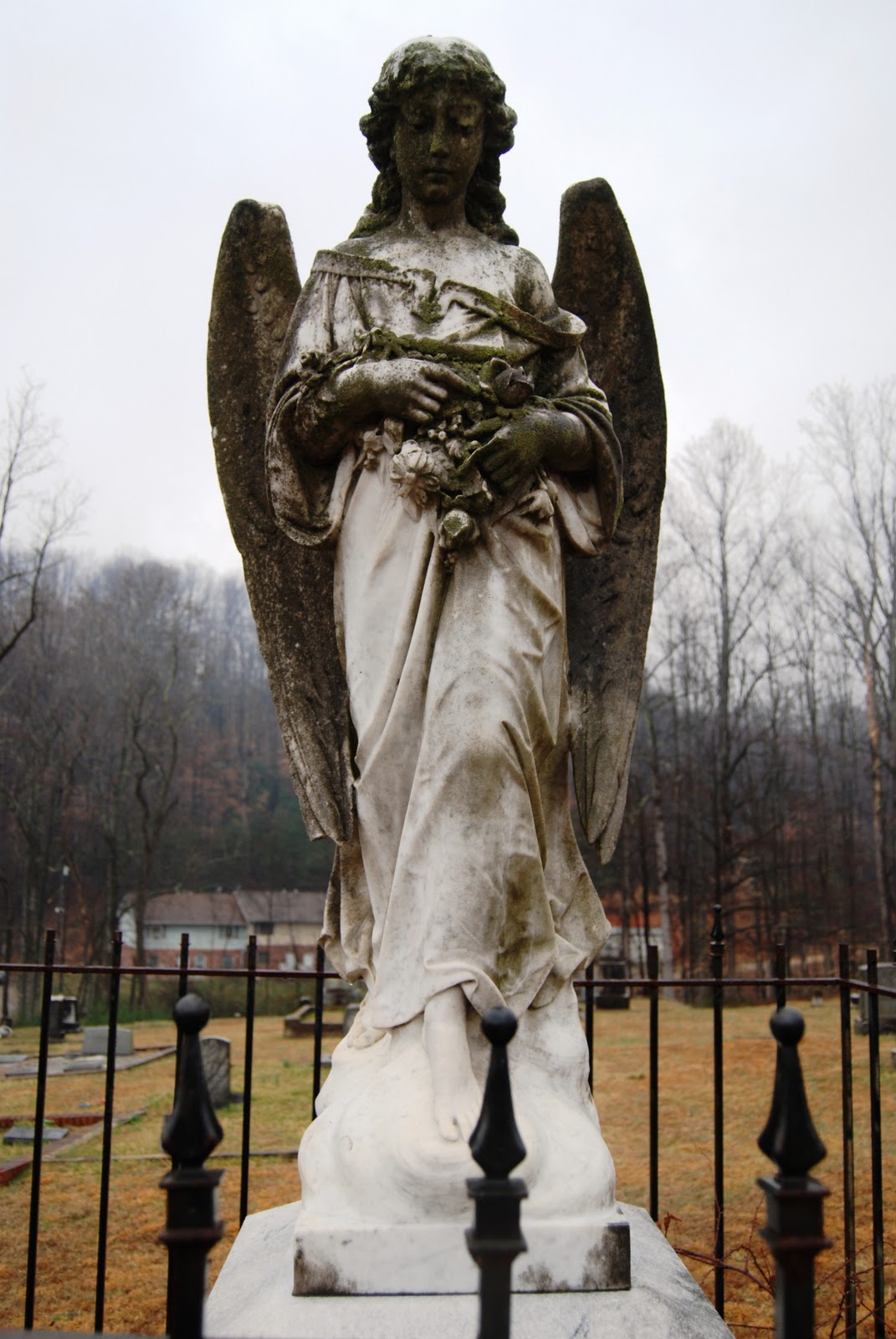
Up the steep hill that is Cemetery Street we went and there it was, the angel statue surrounded by a wrought-iron fence. The story of this statue is that Thomas Wolfe’s father had it made, then lost it in a poker game. The Carrara marble statue that gave Wolfe’s book its name is in a cemetery in Hendersonville on the other side of Asheville. We’ve seen it often when wandering toward Brevard along that road.

Photos made, we headed back to the main street and the Old Fort Depot, now home to a small railroad museum and the local Tourist Bureau. On the day we were there, there was also an arts and crafts show there with handmade textiles, pottery, jewelry and brooms, as well as well-drawn sketches by a local artist. Some of them are members of the Southern Highland Crafts Guild and their work is both artful and unique.

Mike took photos of the giant arrowhead that sits at the intersection by the depot. Thirty feet tall and made of pink granite, it was unveiled in 1930 as a symbol of the peace made in this area between pioneers and Native Americans in the 19th century.

Old Fort is part of the McDowell Quilt Trail, a county-wide display of traditional quilt designs on wooden signs called barn quilts that are attached to buildings. Appropriately, the Railroad Crossing design is affixed to the Depot and a couple of saw designs are displayed on the Old Fort Woodworking building.

Depot Barn Quilt
What we didn’t experience on our Saturday in Old Fort was their famous Mountain Music night. Those events happen on Friday nights and have drawn music lovers for many years for a jam with banjos and guitars, fiddles or dulcimers, maybe an accordion or washtub. As some have described this Friday tradition, the musicians play “just for the joyful noise they make.”

Andrews Geyser
Our next stop was at the locally known Andrews Geyser, a bit out of town and back in the woods. It can be reached by roads that sometimes parallel the railroad track. The geyser is actually a manmade water spout that is turned on in the morning and off in the evening from the lodge above it. It is said to have been built originally by Mill Creek in 1885 for train passengers to see as their cars began the steep climb to Swannanoa Gap. Over the years, the geyser has been moved, restored and then rededicated in its current spot in 1976.

Winding our way back to the main road, we headed west to stop at a couple of our favorite shops in Black Mountain, the Common Housefly (kitchen goods) and the Merry Wine Market. We made a quick stop at Town Hardware, too, for a couple of items. These are places we’ve found in early wandering and now know the people and their wares. They remember us, too.

Along the familiar drive down NC 9 from Black Mountain to Lake Lure, we found wild turkeys, some of them looking as big as small ponies, startled from an early supper in the fields of Ledbetter Farms. All along the roadside, the occasional burst of bright yellow spikes of forsythia shone through the drizzle and fog.

And this day, like other roaming days of exploration and discovery, reassures me that Anatole France was surely right when he wrote: “Wandering re-establishes the original harmony which once existed between man and the universe.”


All photos by Mike Lumpkin

Wednesday, February 16, 2011

Walking in Westview - At Peace with History

Getting interested in one’s family tree could be called a hobby, I guess. For some folks it becomes a life’s work. Those who have been at it for years have developed not just the raw information, but also instinctive approaches to identifying their ancestors. Mike’s cousin, Judy, is a pro, passionate about the pursuit of this particular knowledge and clearly enjoying the adventure.

I am a novice, but already hooked. Reaching into the past, exploring the lives of those who came before. Having begun with the online marvels of Ancestry.com, I’ve moved on to shamelessly query family members, digging names and places out of their memories. I’ve studied the family Bibles and photographs and wished a thousand times that I had paid more attention to my parents’ stories and asked more questions when they were alive.

Raymond Artope's Marker
All this led me to a sunny February afternoon wandering through Westview Cemetery in Southwest Atlanta, a place I haven’t been since the early 1960s when we buried my mother’s mother there. Westview is a huge burial site, complete with an ornate Gothic mausoleum called Westview Abbey. My maternal grandparents are buried on a sloping section almost in the shadow of the three-story Abbey, itself home to a multitude of crypts, according to cemetery information. About 100,000 folks rest in these grounds.

Mike with his camera and I with my notepad entered the rolling grounds that cover about 600 acres through the stone gate flanked by a gatehouse in the same aged stone, rough Georgia granite, cut in blocks of varied sizes. The gatehouse’s Romanesque tower is said to be one of the oldest standing structures in Atlanta. Within a few yards of the entry, Mike spotted a beautiful huge tree (photo above), spreading its magnificent limbs above the grounds.

Our first stop was in the office just inside the gate where a helpful lady looked up the locations of the Artopes and other relatives buried there and with a few clicks on her computer gave us their plot numbers and a map. She thoughtfully starred the maps for us and gave us very specific instructions about how to find first one section then another.

I had some sense of the history of Westview from both family teaching and from Google. Opened in 1884, its early history included a “receiving vault” where coffins were placed in the winter months when the unpaved roads sometimes became mired in icy mud. It would hold only 36 coffins, a reminder that Atlanta in 1884 was much less populated than the sprawling metropolis it has become. Now sealed, the vault’s inscription tells its history.

That story includes the vault’s use for a different reason in 1917-1918 when the influenza epidemic was killing Atlantans at a rapid rate. There is other rich history here, too. As quiet as it was on the day we drove and walked its hallowed ground, it was noisy and filled with both life and death in July, 1864, when the Battle of Ezra Church was fought here. Confederate troops attempted to stop William Tecumseh Sherman’s army here from its “March to the Sea,” but were outmatched. A monument amidst the graves commemorates that battle.

In between visits to the gravesites of our relatives, we found ourselves awed by the burial sites of famous Atlantans like the journalist, Henry W. Grady, for whom the University of Georgia’s School of Journalism is named, and the city’s longtime mayor, Ivan Allen, Jr. There are vaults and memorials in myriad designs and sizes, sometimes appearing to be competing for the beholder’s attention. I couldn’t help but imagine that a competitive spirit might have spurred some families to make a better showing, even in death, than their peers.

There are a number of family “vaults” in Westview. These are small buildings that encompass crypt spaces. One that caught our attention was still decorated for the holidays, including solar-powered lights leading to the door. Through the glass in the door we could see a chair, a table and Valentine decorations. These are  indications of love and grief, loss and a sense of how those left behind cope, telling stories that strangers might not understand, but reminding us that families need to express their feelings in their own ways.

Abbey Facade
Sitting above them all is the Abbey, a remarkable edifice that, for all its immensity, creates a peaceful, however elaborately decorated, respite for those who rest there. When I asked whether there are photographs of the interior, I was told they were not available in the office. A simple typed page of the cemetery’s history was made available with its paragraph extolling the wonders that exist inside the Abbey’s walls. Mike’s photographs of the façade with its tiled mosaics only hint at what might be behind those closed doors. Running out of time, we didn’t attempt to go inside, but there are photographs online.

Abbey Mosaic
Building of the “community Mausoleum” began in 1943, says the brochure. It was planned to “challenge the finest the masters of the past ever built.” It is reported to be the largest structure of its kind ever built under one roof, said to have space for 11,244 entombments. It includes 27 stained glass panels depicting the life of Christ, among paintings and other artworks representing religious texts. A man-made lake once lay below the Abbey to the south, but it was drained in the 1980s.
 
 Our time in Westview answered some of my questions about specific birth and death dates for our family members. The time spent there also was a walk through Atlanta’s history, from the devastation of the Civil War through the late 19th and early 20th century’s “simpler times” to the present. Many famous citizens are buried here, alongside those less well-known, but remembered on markers and stones, small and large. On the day we were there, cemetery workers were preparing sites for those to be buried in the days to come. Only about half of the available land has been developed and there are yet thousands of spaces available in the developed sections.

Even on the chilly winter day we walked in Westview, when its trees were bare of leaves and its grassy hills and valleys were the dull color of a harsher winter than this Southern city usually knows, it was a haven removed from Atlanta’s bustle and rush. It remains a peaceful place, Westview, true to the premise of its original charter -- “a landscape park in which may safely rest the dead.”

All photos by Mike Lumpkin

Sunday, January 23, 2011

Who Knew I'd Find a Sheriff on the Family Tree?

After years of thinking about it, I’ve finally started digging into family history, searching through old records, connecting the dots back from me to whomever I find somewhere back there. And, having started, I’m finding it hard to stop.

It’s like working a puzzle, trying to determine how to take bits of information that you’ve retained from family conversations, the names of relatives met briefly—and maybe only once--at weddings and funerals, and attach them to the family tree. But when you suddenly come upon a census record from the early 20th century that has a name you remember or a parent described as the 2-year-old child of your grandparents, there’s a thrill that runs up your spine. That’s my Daddy, that child whom I knew only as a grown man.

My Mother's Mother, Susie
My spine tingles at least once during each session I spend on Ancestry.com. I’ve found newspaper articles that mention “Mrs. George Artope.” She was returning to Cedartown after a visit with her sister, Mrs. Johnnie Bagwell (whom we knew as Aunt Lula Bagwell), in Atlanta. Now I’m feeling some confusion about this tidbit because Mrs. George Artope was my great-grandmother and Lula Artope Bagwell was her daughter. Maybe the newspaper got it wrong and it was my grandmother, Mrs.Raymond Artope, who was going back to Cedartown. Confusion about which Artope woman was meant, to find any female ancestor in an old newspaper gave me a charge.

By the way, these were not folks of high society by any means. But their visit was mentioned in the 1921 Atlanta Constitution just the same. It was a simpler time. That was long before Facebook was either possible technologically or conceivable intellectually. In those days, it seems, regular folks’ comings and goings in Georgia made the newspaper. The Atlanta paper included our family name in the “East Point News,” East Point being a suburb of Atlanta before being swallowed up by the sprawling city Atlanta became. [I’m struck by the dichotomy of my own mother saying to me in the late 1990s when my name appeared in the Dayton Daily News because of some TV scheduling issue: “In my day, nice women didn’t get their names in the paper, Lee.” Hmmph, Mama, I wish I’d known about Granny (or Great-Grandma) getting her name in the Constitution when you chastised me!

And then, there’s the sheriff. Yes, according to 1880 census records, my great-grandfather on Daddy’s side was a county sheriff at age 31. I’d always known that my father’s mother’s family was well-known in their South Georgia county. There’s even a crossroads there named for them. But, despite the fact that I knew Daddy’s grandfather had married three times (two of the wives were sisters) and sired ten children, I had never heard (or didn’t remember) that he had been the sheriff. By the time the 1900 census was taken, his occupation was listed as “farmer.”

My Mother's Father (right)
And there are the carpenters. I knew my mother’s father was a carpenter. He shared his love of woodworking with us when we were kids, taking us to his basement workshop and making little stools for us to sit on at a safe distance from his sawing and hammering. He made pieces of furniture for us that we still cherish.

What I didn’t know was that I would find carpenters back along the bloodline before him. In the 1880 census records from South Carolina, I found yet another carpenter in the family, this one my mother’s great-grandfather. There’s something in the genes, perhaps, although I’m sad to say that particular part of the genetic code didn’t make it to my generation.

What set me on this course of searching the family tree was sheer curiosity. I have no need to discover that I’m related to anyone famous or rich or royal. What is fascinating me as I explore each new limb on the tree is simply the idea that I’m touching the lives of those who have gone before me. Their experience of life is outlined in the records available, sometimes clearly and other times with more obscure references that leave me wondering and imagining how they lived.

I find myself wishing I had listened more attentively to my parents’ stories about family members. I wish I had asked more questions of parents and grandparents when they were alive. Unfortunately, even the curious among us don’t exhibit enough curiosity in childhood about the “old people.” I missed many chances at weddings and funerals and family reunions. Now I must rely on small snippets of memory to guide my way through the records so that I don’t follow the wrong trail. And I’ve already found that others who are researching available information are willing to share.

I actually have a fairly significant stack of old pictures, some of them tintypes, that were left in my care.  Unfortunately, even my mother didn't know who some of the people in the pictures were or why they had come into our keeping.  I find myself wanting to know their names and why their photographs are in my hands.

So I have begun my quest to know better those who came before me and to attempt to learn what I can about their lives. I imagine my father’s spirit somewhere out there, chuckling that his offspring finally has a deeper appreciation of history.

You were right again, Daddy. It is interesting to learn about the way we were and you were also right that I should have paid more attention to what you tried to tell me. I’m hooked now and determined to document what I learn for those who come after me. And, as you said, it’s fun, too.

Tuesday, January 11, 2011

Sounds and Sights of Southwest Florida

Osprey with lunch
It’s beautiful this Tuesday in Southwest Florida. Some might complain that it’s cloudy rather than sunny, but I’m not one of those people. Instead, I am grateful to be enjoying the call of an osprey from its nest atop a palm tree in my sister’s front yard. I can hear, too, the sound of the little fountain in her pool on the lanai, the occasional rattle of palm fronds in the breeze.

Somewhere north of here friends and family are living with one of those unusual snow and ice storms that come farther south than Nature intended. For Southerners, it’s more fun than not, an opportunity to watch the snow fall, or maybe find something on which to slide down a hill. For those less excited by these conditions, it’s a challenge to clear sidewalks and driveways, find one’s way to work, if necessary, knowing that most of us born in the South don’t drive well in snow and no one really drives well on ice.

But I’m not there today. Instead, I’m basking in 70+ degree temperatures on a little island off the Gulf Coast of Florida. Ft. Myers Beach is a haven for those who choose to escape from winter, whether in Ohio or Hamburg or Middlesex. As we take our morning walks, we say our “mornin” greetings, usually reciprocated with a crisp “morning,” the “g” intact, as pronounced by those raised in the Northern U.S. or Canada. Then there are the distinctly accented responses, those that clearly reflect a homeland across the ocean. This is a popular destination for Brits and Germans.

We take long walks before breakfast, taking pleasure in the soft sea air. This morning there was thick fog across the landscape, limiting visibility beyond a couple of hundred yards. That was tolerable because within our view were so many sights to enjoy.

People-watching is a constant delight here. Those who live here year-round bundle up when the temperature drops below 60 degrees while the visitors are wearing bikinis. Fashion tragedies occur minute-to-minute as every imaginable combination of tank tops, flip-flops, sequins and orthopedic shoes appear. Then there are the midriff-barers who should be arrested for crimes against nature. It’s truly amazing how we human beings choose to attire ourselves.

There was a flock of ibises using their long curved beaks to explore a neighbor’s yard. They were snapping up something that must have been tasty because they weren’t the least bit distracted by our passing close by along the street.

There were all sorts of trees and shrubs we don’t see in North Carolina, some blooming gloriously with huge red or peach-colored flowers. We who are not accustomed to palm trees marvel at the many different varieties of palms, both trees and shrubs.

Then there are the homes themselves. This is an area of canals, so most homes have boats behind them, many with pools covered with the huge “cages” or screens to keep out the summertime bug population. The houses come in a variety of colors with many approaches to the “Florida” look.

There are mailboxes made to look like manatees or dolphins. There are mailbox posts that look like the pilings that hold up docks. There are houses decorated with birds or seahorses or suns.

There are tile roofs and lawns of rocks interspersed with grass lawns that are perfectly manicured. There’s the house down the block that has been abandoned for a couple of years, sitting derelict among well-tended homes, its curtains hanging forlornly, eaves sagging, landscaping unkempt.

And everywhere, all around us and usually in eyesight, there is the water. The water in the bay is an aquamarine color that shimmers under the sun. The ocean water is a darker blue until it reaches the shallows along the gleaming white beaches where it becomes a pale blue-green. Sometimes the canals and creeks and sloughs have water in them that is so dark it appears almost black because you can see through it to the black earth beneath.

This, then, is a visual smorgasbord of land and sea, people and places. As my friend Anne says, it’s a place meant for “nothing to do and all day to do it.” Even as we explore and discover the natural and man-made beauties, we do it on Florida time—no hustle, no bustle, just living life as we come to it.

All photos by Mike Lumpkin